
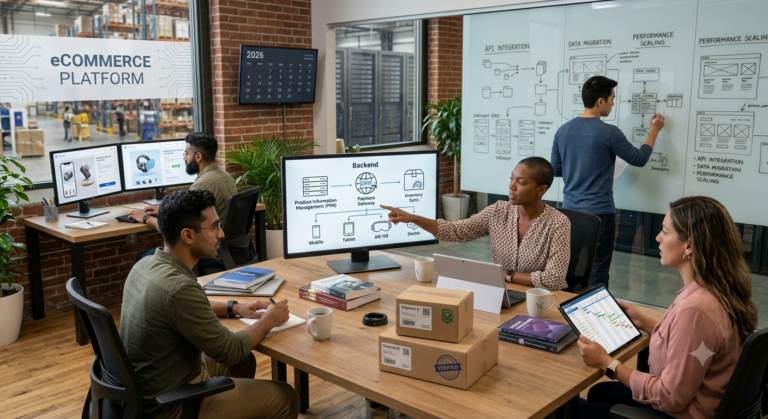
You’ve hit the ceiling on Shopify. Your catalog is too complex, your checkout flow needs logic that no app can replicate, and your operations team is buried in manual workarounds. A custom eCommerce platform starts to look like the obvious answer.
But what does a custom build actually involve? How long does it take? What decisions will land on your desk, and when?
This article walks you through the full eCommerce platform development process – from the first discovery call to post-launch optimization – so you know exactly what you’re getting into before you commit.
Why Businesses Outgrow Off-the-Shelf Platforms
Shopify and WooCommerce are genuinely good tools. For a business in its early stages, they do the job. But growth creates complexity, and complexity is where template platforms start to crack.
Common breaking points include:
- Custom pricing logic – tiered pricing, B2B account pricing, or quote-based workflows that no plugin handles cleanly
- Inventory and ERP integration – syncing product data, stock levels, and order status across systems in real time
- Checkout customization – multi-step flows, custom fields, or conditional logic that hosted platforms simply won’t allow
- Performance at scale – catalog sizes or traffic volumes that push hosted platforms past their limits
- Brand differentiation – a buying experience that looks and works like nothing else in your category
If two or more of these apply to your business, a custom eCommerce build is worth a serious look.
The Custom vs. Shopify Decision
Before committing to a custom build, it helps to be honest about the tradeoff.
Shopify gives you speed, maintained infrastructure, and a large app ecosystem. A custom platform gives you control, flexibility, and a system built around your exact workflows – not the other way around.
The right choice depends on your specific constraints. If your requirements fit within what a hosted platform can do, staying on one is often the smarter call. But if you’re constantly hitting the edges of those platforms, custom eCommerce development pays for itself over time – through fewer workarounds, lower third-party tool costs, and a better experience for your team and your customers.
What the Development Process Actually Looks Like
A well-run custom eCommerce build follows a structured process. At TechYouKnow, every engagement runs through three stages: Analyze, Implement, Optimize. Here’s what each phase looks like in practice.
Phase 1: Analyze
This is discovery, and it’s the most important phase of the entire project.
A good agency won’t start writing code until they understand your business. That means mapping your current workflows, identifying where your existing platform fails you, documenting your integrations – ERP, warehouse, CRM, payment processors – and defining what success looks like in measurable terms.
Expect to answer questions like:
- How does an order move from placement to fulfillment today?
- What does your product data structure look like?
- Who manages catalog updates, and how often?
- What are your peak traffic patterns?
- What does post-launch support look like on your end?
The output of this phase is a clear scope document and a technical architecture plan. If an agency skips this step or rushes through it, that’s a warning sign worth taking seriously.
Phase 2: Implement
This is the build – design, development, and integration.
UI/UX design comes first. Before any code is written, you should see wireframes and high-fidelity mockups of the key pages: homepage, category pages, product detail pages, cart, and checkout. This is where you make decisions about layout, navigation, and the buying flow. Changes at this stage cost time. Changes once development is underway cost time and money.
Once design is approved, development begins. A custom build typically involves:
- Frontend development – the interface your customers interact with
- Backend development – the logic powering pricing, inventory, orders, and accounts
- API integrations – connecting your platform to your ERP, warehouse management system, payment gateway, and any other tools in your stack
- Admin panel – the internal interface your team uses to manage products, orders, and promotions
You should expect regular check-ins and staged deliverables throughout. Weeks of silence with no visibility into progress is not normal, and it’s not acceptable.
Phase 3: Optimize
Launch is not the finish line.
A custom eCommerce platform needs to be monitored, measured, and improved after it goes live. This phase covers performance monitoring, bug fixes, A/B testing on key conversion points, and iterative improvements based on real data.
The best agencies treat optimization as an ongoing part of the engagement. If your agency hands you a finished product and disappears, you’re on your own the moment something breaks – or the moment your business needs to evolve.
Key Decisions You’ll Make During the Build
Custom builds require your input at several points. Being prepared for these decisions keeps the project moving and cuts down on unnecessary back-and-forth.
Architecture decisions happen early. Will this be a headless build with a decoupled frontend? Will it integrate with an existing ERP or require a new data layer? These choices shape everything downstream.
Integration priorities need to be ranked. Not every integration can be built in phase one. Knowing which systems are critical at launch versus which can come later keeps the scope clean and the timeline realistic.
Content and catalog readiness is consistently underestimated. A custom platform needs your product data in a structured format. If your catalog is messy or incomplete, that becomes a project blocker – not the agency’s problem to solve.
Approval workflows for design and development need to move fast. Every day a decision sits in someone’s inbox is a day added to the timeline.
How Long Does a Custom eCommerce Build Take?
Timelines depend on scope, integration complexity, and how quickly your team can provide input and approvals. A focused build with a clear scope and clean data moves faster than a complex build with multiple ERP integrations, custom pricing logic, and a large catalog.
What matters more than any specific number is that your agency gives you a realistic timeline upfront, breaks it into milestones, and communicates clearly when something changes. Vague timelines are how projects go sideways.
What to Look for in an eCommerce Platform Agency
Not all agencies operate the same way. When you’re evaluating partners, look for:
- A documented process – not just a list of services, but a clear methodology for how they actually run engagements
- Relevant case studies – work that shows they’ve solved problems similar to yours
- Integration experience – especially if you have an ERP or complex backend that needs to connect to the platform
- Post-launch support – clarity on what happens after you go live, not just before
- Direct communication – a team that talks to you plainly, not one that hides behind jargon or vague status updates
The agencies that cause the most frustration are the ones that sell outcomes but deliver hours. You want a partner who’s accountable to results, not one billing you for time spent.
FAQs
What is custom eCommerce platform development?
It’s the process of building an online store from the ground up – designed around your specific business logic, integrations, and customer experience requirements, rather than forcing your business to fit a template platform.
How is a custom eCommerce build different from Shopify or WooCommerce?
Hosted platforms give you pre-built infrastructure with limited customization. A custom build gives you full control over the architecture, checkout logic, integrations, and design. The tradeoff is a higher upfront investment in exchange for a system that fits your business exactly.
What integrations are typically included in a custom eCommerce build?
Common integrations include ERP systems, warehouse management platforms, payment gateways, CRM tools, shipping carriers, and marketing automation platforms. The specific integrations depend on your existing tech stack and how your operations run.
How long does a custom eCommerce platform take to build?
It depends on scope and complexity. A well-scoped project with clean data and fast approvals moves faster than one with multiple complex integrations or an unclear brief. A reputable agency will give you milestone-based timelines rather than a single delivery date.
What should I prepare before starting a custom eCommerce build?
Have a clear picture of your current workflows, your integration requirements, your product catalog structure, and what a successful launch actually looks like for your business. The more prepared you are going into discovery, the smoother the build will be.
How do I choose the right eCommerce platform agency?
Look for a documented delivery process, relevant case studies, clear communication, and a team that asks good questions before proposing solutions. Avoid agencies that skip discovery or hand you a proposal before they understand your business.
What happens after the platform launches?
Post-launch work includes performance monitoring, bug fixes, and iterative improvements based on real usage data. A good agency builds this into the engagement rather than treating launch as the end of the relationship.
Ready to Build Something That Actually Fits Your Business?
A custom eCommerce platform is a serious investment. It’s also the right move when your current platform is holding you back.
If you’re at that point, the next step is a conversation. TechYouKnow works with mid-market businesses and growth-stage companies to build eCommerce platforms that fit their operations – not the other way around. The process starts with structured discovery, moves through a transparent build, and continues with post-launch optimization.
Book a free consultation at TechYouKnow and find out what a custom build would actually look like for your business.