You’ve outgrown your current setup. Orders are coming in, but your store can’t keep up. You’re manually updating inventory, losing customers at checkout, and duct-taping together integrations that were never designed to work as a system.
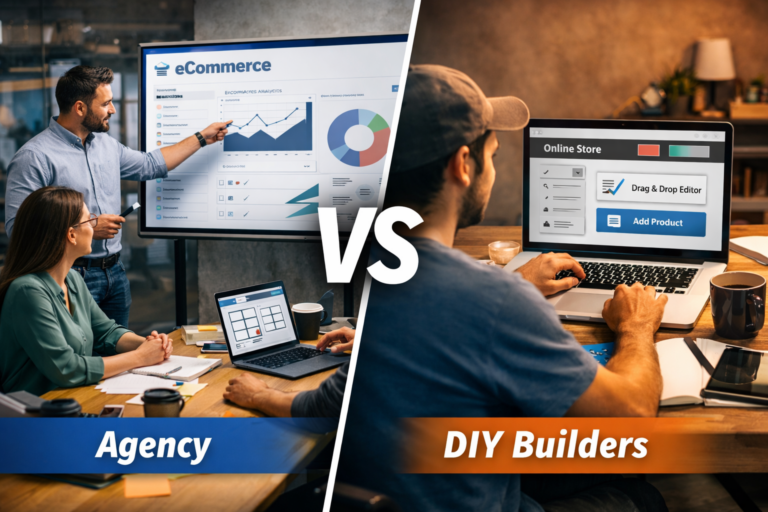
So you face a real choice: build it yourself with a DIY platform, or bring in an eCommerce platform development agency to build something that actually fits your business.
Both paths have genuine trade-offs. Here’s how to think through them — not just for where your business is today, but for where it’s going.
What DIY eCommerce Builders Actually Give You
Platforms like Shopify, WooCommerce, and BigCommerce have made it genuinely easy to get a store live fast. For early-stage businesses testing a product or entering a new market, that speed is real and valuable.
The DIY route gives you:
- Low upfront cost. Monthly fees and app subscriptions keep initial spend manageable.
- Templates and drag-and-drop editors. You can have something live in days without writing a line of code.
- Built-in hosting and basic security. The infrastructure is handled for you.
- App marketplaces. Thousands of plugins covering payments, shipping, email, and more.
For a solo founder or a small business under $500K in annual revenue, this is often the right starting point. There’s no reason to over-engineer before you’ve validated demand.
Where DIY Starts to Break Down
The issue isn’t that DIY platforms are bad. It’s that they’re built for the average business — not yours.
As you scale, the gaps become harder to ignore:
- App stacking gets expensive and fragile. Every integration adds a monthly fee and a potential failure point. A store running 15 to 20 apps can spend more on subscriptions than a custom build would have cost.
- You’re boxed in by the platform’s logic. Checkout flows, product structures, pricing rules, fulfillment workflows — all of it has to fit inside what the platform allows. If your business model doesn’t match that template, you’re constantly working around it.
- Performance degrades. Bloated themes and third-party scripts slow page load times, which directly hurts conversion rates.
- You don’t own your data. Customer records, order history, and analytics live inside someone else’s system. Migrating later is painful and expensive.
- Support is generic. When something breaks, you’re in a ticket queue or a community forum.
If you’re doing serious volume, managing complex product catalogs, running B2B pricing tiers, or integrating with a warehouse or ERP system, DIY platforms stop being a shortcut and start being a ceiling.
What an eCommerce Platform Development Agency Actually Builds
Working with an eCommerce platform development agency means you’re not adapting your business to fit a template. The platform is built around how your operations actually work.
That includes:
- Custom checkout and cart logic designed around your specific conversion goals
- Direct integrations with your inventory, fulfillment, CRM, or ERP system
- Scalable architecture that handles traffic spikes without degrading performance
- Tailored UI/UX design that matches your brand and guides customers toward purchase
- Clean data ownership so your customer and order data belongs to you
The result is a platform that works the way your business works — not the other way around.
The Real Cost Comparison
This is where most businesses get the math wrong. They compare the upfront cost of a custom build against a DIY monthly subscription and assume DIY is cheaper. Run the numbers over three years and the picture shifts.
A growing mid-market business on a DIY platform is often paying for the platform subscription, 10 to 20 app integrations, a developer on retainer to patch things, performance optimization tools, and lost revenue from conversion problems the platform simply can’t fix. That adds up faster than most operations directors expect.
A custom build carries a higher upfront investment, but it eliminates most of those recurring costs, performs better from day one, and doesn’t force a rebuild when you hit the platform’s limits.
The Decision Framework: Which Path Is Right for You?
Use this to pressure-test your situation.
Choose DIY if:
- You’re validating a new product or market
- Your catalog is simple and your fulfillment process is standard
- You’re processing fewer than 500 orders per month
- You don’t need deep integration with other business systems
- Speed to market matters more than long-term flexibility
Choose a development agency if:
- You’re doing real volume and need a platform that scales with you
- Your business runs on custom pricing, B2B workflows, or complex catalog logic
- You need tight integration with an ERP, warehouse, or CRM system
- Your current platform is slowing you down or costing you conversions
- You’ve already tried DIY and you’re hitting its limits
For most mid-market businesses, the honest answer is that they started on DIY, grew past it, and are now paying the cost of that ceiling every month.
What to Look for in an eCommerce Platform Development Agency
Not all agencies deliver the same thing. Before you sign anything, ask these questions:
Do they start with your business, not their preferred stack? A good agency analyzes your operations, your customer journey, and your growth goals before recommending a solution. If they lead with a technology pitch before understanding your business, walk away.
Do they have a documented delivery process? Vague timelines and unclear deliverables are the most common complaints about agency work. Look for a team that can show you exactly how a project moves from scoping to launch — not just describe it in general terms.
Can they handle more than just the front end? If your eCommerce platform needs to connect with an ERP, inventory system, or mobile app, you want one team that can build all of it. Managing multiple vendors on a single project creates gaps and finger-pointing when things go wrong.
Do they have relevant case studies? Ask to see work at your scale or in your industry. Generic portfolio pieces don’t tell you much about what you’ll actually get.
At TechYouKnow, eCommerce platform development runs through a structured three-step process: Analyze, Implement, Optimize. Every project starts with a deep dive into your business before a single line of code is written. That’s not a tagline — it’s how the work actually gets done.
You can see that process in practice on the case studies page, which includes work across industries from industrial systems to writing platforms to marketing builds.
The Hidden Cost of Getting This Wrong
Choosing the wrong path doesn’t just cost money. It costs time.
A business that spends 18 months on a DIY platform before realizing it needs a custom build has to migrate its data, retrain its team, rebuild its integrations, and absorb the lost revenue from a platform that was holding it back the entire time. That’s a real setback — and a preventable one.
The businesses that move fastest are the ones that make the right infrastructure decision early, before the pain becomes obvious.
FAQs
What does an eCommerce platform development agency actually build? A custom online store built around your specific operations — including checkout flows, product catalog structures, payment integrations, fulfillment logic, and connections to other systems like ERPs or CRMs. The output is a platform shaped around how your business works, not a template you have to adapt to.
When does it make sense to move from a DIY builder to a custom platform? The clearest signals: you’re hitting the limits of your platform’s functionality, your app stack is getting expensive and unstable, you need integrations that off-the-shelf tools can’t handle, or your conversion rate is suffering because of platform constraints. Most mid-market businesses hit this point somewhere between $1M and $5M in annual eCommerce revenue.
How long does it take to build a custom eCommerce platform? It depends on complexity. A straightforward custom build with standard integrations might take 8 to 12 weeks. A more complex platform with ERP integration, custom pricing logic, and a large catalog can take 4 to 6 months. Any agency quoting you a fixed timeline before understanding your requirements is guessing.
Can a custom eCommerce platform integrate with my existing ERP or inventory system? Yes — and this is one of the strongest reasons to go custom. A development agency can build direct integrations between your eCommerce platform and your ERP, warehouse management system, or CRM. DIY platforms can do this through third-party apps, but those connections are often fragile and limited in scope.
What’s the difference between eCommerce platform development and website development? Website development covers your public-facing presence: pages, content, branding, and lead generation. eCommerce platform development is specifically about building the infrastructure that handles transactions, inventory, pricing, fulfillment, and customer accounts. Many businesses need both, and building them together under one team produces better results than treating them as separate projects.
How do I evaluate an eCommerce platform development agency before hiring them? Ask for case studies relevant to your industry and scale. Ask them to walk you through their delivery process step by step. Ask how they handle scope changes and what support looks like after launch. An agency that can answer those questions clearly — without vague promises — is worth a deeper conversation.
Is a custom eCommerce platform worth the investment for a mid-market business? For most mid-market businesses doing meaningful volume with complex operations, yes. The upfront investment is higher than a DIY subscription, but a custom platform cuts recurring app costs, performs better, scales without artificial limits, and gives you full ownership of your data. The businesses that regret going custom are rare. The ones that regret staying on DIY too long are not.
The right platform depends on where you are and where you’re headed. If you’ve outgrown DIY and need something built to your actual operations, the next step is a straightforward conversation about what that looks like.
Book a free consultation at TechYouKnow and get a clear picture of what a custom eCommerce platform build would mean for your business.