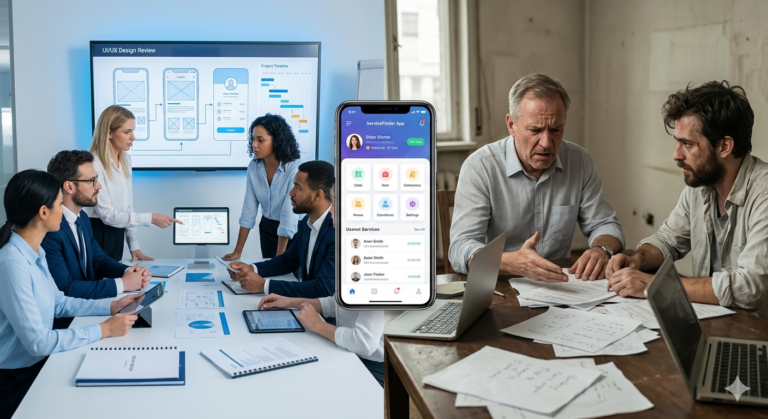
You’ve got an app idea, a budget, and a deadline. What you don’t have is time to waste on an agency that overpromises, under-delivers, and hands you something held together with duct tape.
Picking the wrong development partner is an expensive mistake — we’re talking months of lost time, a product that needs to be rebuilt from scratch, and a team that’s already moved on to their next client. This guide helps you avoid that.
Here’s what to look for, what to ask, and what red flags to walk away from.
Why Most App Development Partnerships Go Wrong
The problem usually isn’t technical skill. Most agencies can write code. The problem is process, communication, and a shared understanding of what “done” actually means.
Businesses get burned when they choose a vendor based on price alone, skip due diligence on past work, or sign a contract without understanding how delivery actually works. The result is a project that drags on, scope that balloons, and a final product that barely resembles what was discussed in the first meeting.
Knowing where things go wrong is the first step to making a better call.
6 Things to Evaluate Before You Sign Anything
1. Their Portfolio Matches Your Type of App
A company that builds gaming apps isn’t automatically qualified to build a healthcare tool or an operations platform for a logistics business. The technical overlap exists, but the domain knowledge, compliance awareness, and UX thinking are completely different.
Ask to see work that’s similar to what you need — not just impressive-looking screens. If they’ve built consumer apps but you need a B2B workflow tool, that gap matters.
2. They Have a Defined Delivery Process
Vague timelines are a warning sign. A credible mobile app development company should be able to walk you through exactly how a project moves from kickoff to launch — how decisions get made, how feedback gets incorporated, and what happens when requirements change.
Look for a structured methodology. At TechYouKnow, every project runs through a three-step framework: Analyze, Implement, Optimize. The team digs into your business goals before writing a single line of code, builds to those goals, then refines based on real performance data. That kind of structure protects you from scope creep and misaligned expectations — two things that kill otherwise good projects.
3. They Understand Your Business, Not Just Your Brief
The best development partners ask questions that go beyond the spec sheet. Who are your customers? What problem does the app actually solve? How will success be measured? What happens after launch?
If a company jumps straight to quoting you without asking those questions, they’re treating your project like a ticket. That’s a staff-augmentation mindset, and it rarely produces outcomes worth talking about.
4. UI/UX Is Built In, Not Bolted On
A lot of development shops treat design as an afterthought — build the functionality first, then hand it to a designer to make it look presentable. That approach produces apps that work technically but frustrate the people who actually use them.
Strong UI/UX design belongs inside the development process, not tacked on at the end. The interface should be built around how real people think and behave, not around what’s easiest to code. If the agency you’re evaluating doesn’t have serious UI/UX capability in-house, that’s a gap worth taking seriously.
5. They Can Support You After Launch
An app isn’t a one-time deliverable. It needs updates, bug fixes, performance monitoring, and iteration based on how real people use it. Ask any prospective partner what post-launch support looks like and whether it’s included or billed separately.
Agencies that disappear after handoff leave you dependent on documentation and whoever you can find next to maintain their code. That’s a fragile position to be in.
6. Their Case Studies Are Specific
Testimonials that say “great team, loved working with them” tell you almost nothing. What you want are case studies that describe the actual problem, the approach taken, and the measurable outcome.
Look at the depth of their published work. TechYouKnow’s case studies cover projects across industries — industrial systems, healthcare, SaaS platforms — with enough detail to understand how the team actually thinks and delivers.
Questions to Ask in Your First Meeting
Don’t walk into a discovery call without a list. These are the questions that separate serious agencies from everyone else:
- How do you handle scope changes mid-project?
- Who will be my primary point of contact, and how often will we communicate?
- What does your QA process look like before launch?
- Have you built apps in my industry before? Can I speak with that client?
- What does handoff look like, and what do I own at the end?
- What happens if the project runs over timeline or budget?
Pay attention to how they answer, not just what they say. Confident, specific answers signal a team that’s been through this before. Vague or defensive answers signal the opposite.
Red Flags That Should Stop You Cold
Some warning signs are easy to miss when you’re excited about a project. Watch for these:
- No discovery phase. If they quote you before understanding your business, the quote is meaningless.
- Only offshore junior developers on your project. Ask who will actually be building your app and what their experience level is.
- No clear IP ownership clause. You should own your code, your design files, and your data. Full stop.
- Unrealistically fast timelines. A well-built mobile app takes time. Anyone promising a production-ready product in two weeks is either cutting corners or setting you up for a rebid.
- No post-launch plan. If they can’t describe what happens after you go live, the relationship ends at handoff.
What a Good Engagement Actually Looks Like
A good mobile app development company starts by understanding your goals, not your feature list. They scope based on outcomes, not hours. They keep you informed throughout the build. They deliver something that works for real people. And they stay engaged after launch to make sure it keeps working.
That’s not a high bar. But it’s one a surprising number of agencies fail to clear.
If you’re evaluating partners for a mobile app project, TechYouKnow offers a free consultation to help you scope your project, pressure-test your requirements, and understand what a realistic build looks like — before you commit to anything.
FAQs
How much does it cost to hire a mobile app development company in 2026? It depends on complexity, platform, and the agency’s model. Simple apps with limited functionality can start around $15,000 to $30,000. Custom builds with integrations, complex workflows, or both iOS and Android typically range from $50,000 to $150,000 and above. Be cautious of quotes that seem unusually low without a clear explanation of what’s included.
How long does it take to build a mobile app? A well-scoped MVP typically takes three to six months from kickoff to launch. More complex apps with backend integrations, custom APIs, or enterprise-level requirements can run six to twelve months. Any agency quoting a timeline before understanding your requirements is guessing.
Should I build for iOS, Android, or both? That depends on your audience. If your customers are primarily in North America and skew toward higher income brackets, iOS tends to drive higher engagement. Android has broader global reach. Cross-platform frameworks can reduce cost, but native builds generally perform better for complex interactions. A good development partner will help you make this call based on your specific goals.
What’s the difference between a mobile app development company and a freelancer? A freelancer can be cost-effective for simple projects but carries real risk around availability, accountability, and breadth of skill. A development company brings a team with defined roles, a structured process, and continuity if one person leaves. For anything beyond a basic prototype, a company engagement typically produces more reliable outcomes.
How do I know if a mobile app development company is actually good? Look at their case studies in detail — not just their client logos. Ask to speak with past clients directly. Pay attention to how they handle your first conversation: do they ask smart questions about your business, or do they jump straight to quoting? Process transparency and domain knowledge are better signals than portfolio aesthetics alone.
What should I own at the end of a mobile app project? You should own the source code, all design files, any third-party licenses purchased for your project, and full access to any accounts or repositories created on your behalf. Get this confirmed in writing before the project starts.
What questions should I ask a mobile app development company before hiring them? Focus on process, communication, and accountability. Ask how they handle scope changes, who your day-to-day contact will be, what QA looks like, what post-launch support is included, and what you own at the end. The quality of their answers tells you more than any sales deck.
Choosing a mobile app development company is a high-stakes decision. The right partner saves you time, money, and a lot of frustration. The wrong one costs you all three.
Start with process clarity, verify it with real case studies, and never skip the conversation about what happens after launch. When you’re ready to get specific, book a free consultation with TechYouKnow and get honest answers before you commit to anything.