Most businesses don’t fail at technology. They fail at the process around it.
They hire an agency, get handed off to a junior team, and receive something that barely resembles the original brief. Then they spend months fixing what should have worked from day one. If you’ve dealt with vague timelines, moving goalposts, or a vendor who went quiet after launch — you already know how this goes.
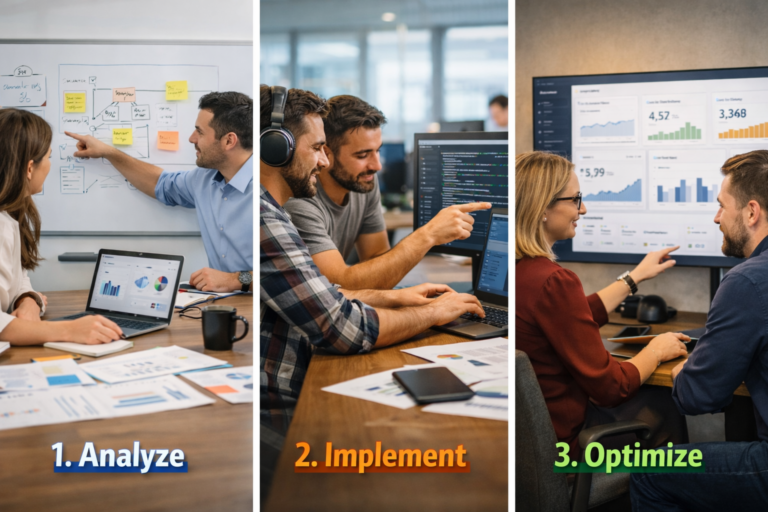
At TechYouKnow, our entire delivery model was built around that exact problem. Every project we take on — whether it’s a custom ERP system, an eCommerce platform, a mobile app, or a website — runs through the same three-step framework: Analyze, Implement, Optimize.
Not a tagline. The actual way we work.
Here’s what each step looks like in practice, and why it matters for your business.
Step 1: Analyze — Understand the Problem Before Writing a Single Line of Code
The most expensive mistake in digital development is building the wrong thing quickly. A lot of agencies jump straight to wireframes or sprint planning before they’ve genuinely understood your business. We don’t.
The Analyze phase is where we do the hard thinking upfront. We dig into your current operations, your goals, your constraints, and the gap between where you are and where you need to be. For an ERP engagement, that means mapping existing workflows, pinpointing where manual processes are bleeding time and money, and defining what “done” actually looks like. For an eCommerce platform build, it means understanding your catalog complexity, fulfillment model, conversion goals, and customer journey.
This phase is structured, not open-ended. We use a presale questionnaire to gather the right information before scoping begins — so you get clarity on what’s being built and why before any budget is committed.
The output of Analyze isn’t a document. It’s alignment. You and your team know exactly what we’re building, why we’re building it, and how we’ll measure success.
Why This Step Gets Skipped — and Why That’s Costly
Enterprise-scale agencies often skip deep analysis for mid-market clients because it doesn’t fit their billing model. You get a templated discovery process that produces a generic scope, not a real understanding of your business. That’s how projects end up over budget and under-delivered.
For growth-stage businesses and operations directors, this is where the real value gets created. Every hour spent in Analyze saves multiples in rework later.
Step 2: Implement — Build What Was Agreed, On Time, With Visibility
Once alignment is in place, we build. The Implement phase is where strategy becomes software.
Depending on your project, that might mean developing a custom ERP system that connects your inventory, finance, and operations data in one place. It might mean building an eCommerce platform designed to drive conversions from day one. It could mean designing and developing a mobile app for iOS and Android with UI/UX your clients actually want to use — or launching a website that reflects your brand and turns visitors into leads.
What separates this phase from what most agencies deliver is visibility. You’re not waiting weeks for a status update. You know what’s being built, what’s been completed, and what’s next. Deliverables are tied to outcomes, not hours.
What We Build
Our implementation work covers five core service areas:
- ERP system development for businesses that have outgrown spreadsheets and disconnected tools
- eCommerce platform development for retailers and product businesses that need a platform built around their specific operations
- Website development from concept to launch, with clean architecture and conversion-focused design
- Mobile app design for iOS and Android, built with real usability in mind
- UI/UX design that puts your clients’ experience at the center of every decision
Each service is delivered as a complete engagement — not a set of billable hours. You get a working product, not a work log.
Step 3: Optimize — Keep Improving After Launch
Most agencies disappear after launch. You get a handoff document, a few weeks of support, and then you’re on your own. That’s not how good digital infrastructure works.
The Optimize phase is where we take what’s been built and make it better — analyzing real performance data, identifying friction points, and making targeted improvements that move the metrics that matter. More conversions. Faster operations. Less manual overhead. Better client experiences.
For ERP clients, optimization might mean refining reporting dashboards, adjusting workflow automations, or integrating a new data source as the business scales. For eCommerce clients, it might mean testing checkout flows, improving page load performance, or expanding platform capabilities as the catalog grows.
Optimization isn’t a separate retainer you have to negotiate after the fact. It’s built into how we think about every project from the start.
Why This Process Works for Mid-Market and Growth-Stage Businesses
The three-step framework isn’t just a delivery method — it’s a practical advantage for businesses that can’t afford to lose six months on a project that misses the mark.
Enterprise agencies like Itransition or Intellectsoft are built for Fortune 500 engagements. Their processes are designed for large teams, long timelines, and enterprise procurement cycles. That works fine if you’re a global manufacturer. It’s a poor fit if you’re a 150-person retail operation that needs a custom ERP live in four months.
TechYouKnow operates differently. We bring ERP system development, eCommerce platform development, mobile app design, and UI/UX design together under one roof — without the overhead or hand-off chains that slow larger firms down. You work with a team that owns the outcome, not a project manager routing tickets between departments.
The Analyze, Implement, Optimize model is also what separates us from offshore vendors who deliver hours instead of results. When every phase has a defined output and a clear success metric, there’s no ambiguity about what you’re getting.
Real Projects, Real Outcomes
This process has been applied across industries and project types. We’ve built an industrial system for Emerson, a writing platform for Smodin, a wellness mobile app, a healthcare mobile app, and a project for Vibe Marketing. Every one of them started with a structured Analyze phase, moved through a defined implementation, and was refined through ongoing optimization.
You can see the details in our case studies.
The through-line is consistent: a clear process produces predictable results.
Start With a Free Consultation
If you’re evaluating digital agencies in 2026, the most important question to ask isn’t about tech stack or team size. It’s about process.
Ours is documented, repeatable, and built specifically for businesses that need real digital infrastructure done right the first time.
Book a free consultation and we’ll start with the Analyze phase. You’ll walk away with a clear picture of what you need, what it takes to build it, and whether we’re the right team to do it.
Frequently Asked Questions
What is TechYouKnow’s 3-step process? TechYouKnow uses a structured delivery framework called Analyze, Implement, Optimize. Every project starts with a deep analysis of your business goals and current operations, moves into a defined implementation phase where the product is built, and then enters an optimization phase where performance is measured and improved.
What types of businesses does TechYouKnow work with? TechYouKnow works with mid-market businesses typically ranging from 50 to 500 employees in product, retail, and services, as well as early-stage startup founders who need an MVP built quickly. The common thread is businesses that need custom digital infrastructure and don’t have an internal development team.
What services does TechYouKnow offer? TechYouKnow offers ERP system development, eCommerce platform development, website development, mobile app design for iOS and Android, UI/UX design, and free AI consulting for small businesses.
How is TechYouKnow different from larger digital agencies? Unlike enterprise-scale agencies built for Fortune 500 clients and long procurement cycles, TechYouKnow is designed for speed and process clarity. ERP, eCommerce, mobile, and UI/UX are all delivered under one roof — no overhead, no hand-off chains, no ambiguity about who owns the outcome.
How long does a typical project take? It depends on scope and complexity. The Analyze phase establishes a realistic timeline before any development begins, so you know what to expect before committing to a build.
Is there a cost to get started? The first step is a free consultation. AI consulting for small businesses is also offered at no cost. All other project engagements are priced on a project basis, with pricing available on request after an initial scoping conversation.
How do I know the project will deliver measurable results? The Analyze phase defines clear success metrics before implementation begins. The Optimize phase uses real performance data to refine the product after launch. Every engagement is tied to business outcomes — not billable hours.